

Socotra
Socotra Island: The Complete Guide to One of the Most Extraordinary Places on Earth
Socotra is a place that seems almost impossible until you see it for yourself.
Rising from the waters of the northwestern Indian Ocean near the Gulf of Aden, the Socotra Archipelago belongs to Yemen but feels completely unlike the landscapes most travelers associate with the Arabian Peninsula. Its mountains, limestone plateaus, enormous sand dunes, turquoise lagoons, coral reefs, caves, and strange endemic plants have developed in relative isolation for millions of years.
The result is one of the most biologically distinctive island environments on Earth.
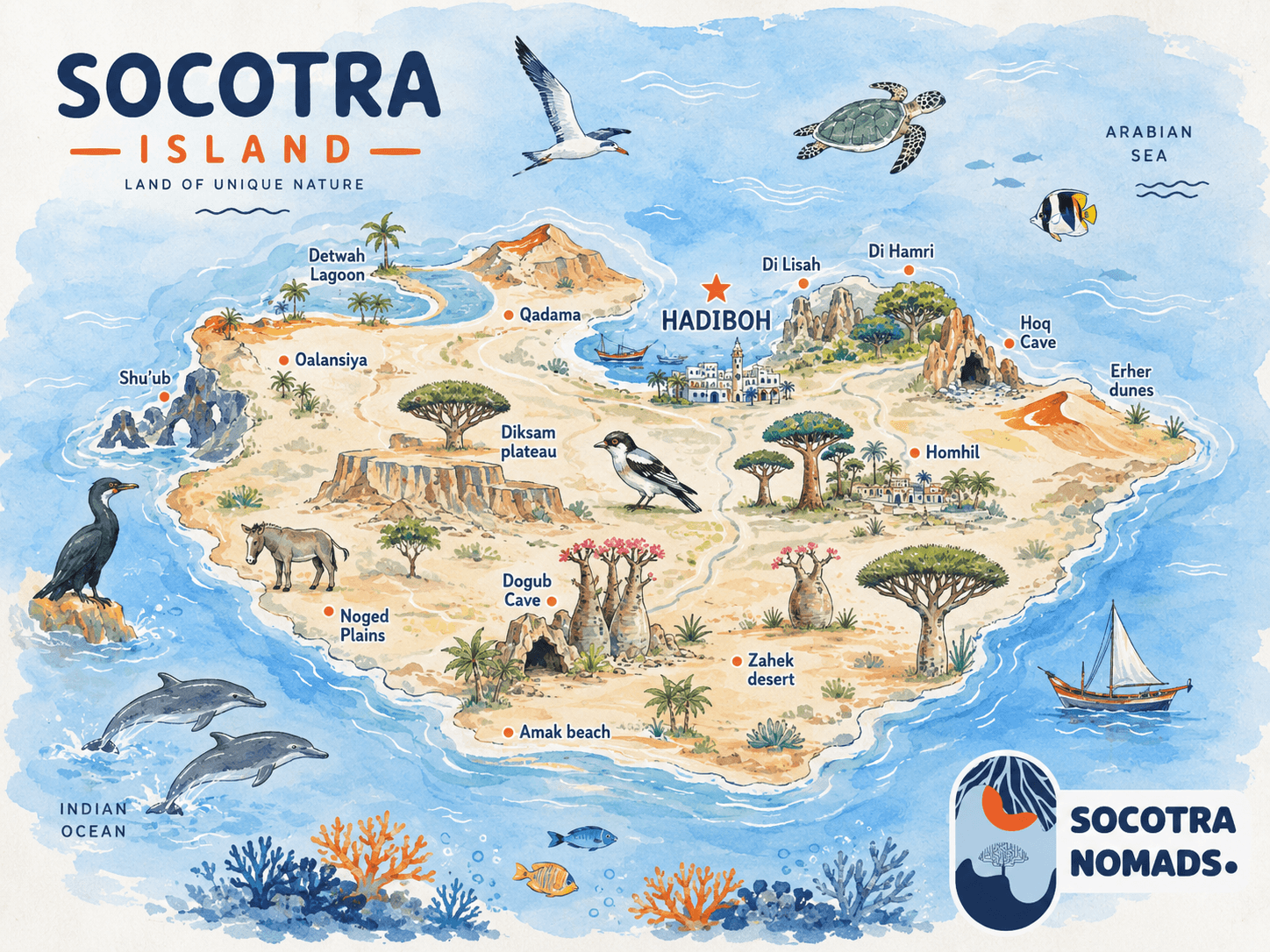
Socotra is especially famous for the Dragon’s Blood Tree, with its enormous umbrella-shaped crown and deep red resin, but the island is far more than a destination built around a single unusual plant. Visitors can swim above coral reefs at Dihamri, hike through ancient tree forests in Diksam, explore the enormous chambers of Hoq Cave, climb dunes beside the sea at Arher, camp beneath clear night skies, walk through Detwah Lagoon, and travel by boat to the remote beaches of western Socotra.
At the same time, Socotra is home to communities with their own language, traditions, knowledge of the land, and centuries-old relationship with the island’s environment.
UNESCO describes Socotra as globally important for biodiversity conservation and notes that the archipelago contains 825 plant species, with 307—or about 37%—found nowhere else in the world. Around 90% of its reptile species and 95% of its land-snail species are endemic. Its surrounding waters are also remarkably diverse, supporting hundreds of species of coral, coastal fish, crabs, lobsters, and shrimp. The Socotra Archipelago was inscribed on the UNESCO World Heritage List in 2008 because of this exceptional biodiversity.
Where Is Socotra?
Socotra lies between the Arabian Peninsula and the Horn of Africa, near one of the world's most historically important maritime corridors.
Although politically part of Yemen, the main island lies much closer geographically to the Horn of Africa than many people expect. Its location near the entrance to the Gulf of Aden placed Socotra along ancient maritime routes connecting Arabia, East Africa, India, and the wider Indian Ocean world.
The entire Socotra Archipelago extends roughly 250 kilometres and consists of four main islands and two rocky islets. Socotra is by far the largest and most populated island, while Abd al Kuri, Samha, and Darsa form the other principal islands.
This geographic position has influenced nearly every aspect of Socotra's story.
The island's isolation helped unusual species evolve independently, while its position beside maritime routes brought sailors, merchants, and travelers from distant regions into contact with local communities.
In that sense, Socotra has always existed between two worlds: biologically isolated but historically connected.
Why Socotra Looks So Different
Much of Socotra's strange appearance can be explained by its long geological and ecological isolation.
For millions of years, plants and animals on the archipelago developed under conditions different from those on nearby continental landmasses. Species adapted to strong winds, limited freshwater, rocky terrain, seasonal rainfall, and intense sunlight.
The result is a landscape filled with forms rarely seen elsewhere.
Trees grow with enormous umbrella-shaped crowns.
Succulent plants develop swollen trunks that store water.
Rocky plateaus contain species capable of surviving in extremely dry conditions.
Mountain valleys support different vegetation from the coastal plains, while caves create their own dark ecosystems.
Socotra is therefore not one uniform landscape. Moving across the island can feel like passing through several completely different environments within a single day.
You might begin the morning surrounded by Dragon’s Blood Trees on a misty plateau, descend through a canyon in the afternoon, and end the day beside enormous dunes overlooking the Arabian Sea.
That variety is one of the main reasons Socotra feels so extraordinary.
The Dragon’s Blood Tree
No plant is more closely associated with Socotra than the Dragon’s Blood Tree, Dracaena cinnabari.
Its enormous crown spreads outward like an umbrella turned inside out. From a distance, groups of these trees create silhouettes that immediately distinguish Socotra from almost anywhere else in the world.
The tree's unusual structure is not simply decorative.
Its tightly packed crown can help capture moisture from mist and light rainfall while also shading the ground beneath it and reducing evaporation. These adaptations help the tree survive in the island's dry highland environments.
The name "Dragon's Blood" comes from its deep red resin.
For centuries, the resin was collected and traded. It has historically been associated with dyes, varnishes, incense, traditional medicine, and other uses. This valuable product connected Socotra with ancient trade networks long before travelers began visiting the island for tourism.
Today, the best-known Dragon's Blood Tree landscapes are around Diksam Plateau and Firmihin Forest.
Walking through these areas is one of Socotra's signature experiences. Mature trees rise from rocky ground in every direction, often with mountains and deep valleys behind them.
Yet these forests are not invulnerable. Slow regeneration, grazing, climate pressures, infrastructure development, and changing environmental conditions have raised concerns about their long-term survival.
Protecting young trees is particularly important because replacing mature specimens can take many years.
A Global Center of Biodiversity
Socotra's importance extends far beyond the Dragon's Blood Tree.
UNESCO records 825 plant species across the archipelago, including 307 endemic species. In other words, more than one-third of Socotra's recorded plants occur naturally nowhere else on Earth.
The same pattern appears among animals.
UNESCO reports exceptionally high reptile endemism, with about 90% of the native reptile species restricted to the archipelago. Land snails show even higher levels, with roughly 95% endemism.
Birdlife is also significant. UNESCO's World Heritage documentation records 192 bird species, including resident breeders and migratory visitors. The archipelago provides important habitat for terrestrial and marine birds.
This extraordinary combination of species has led Socotra to be described as the “Galápagos of the Indian Ocean.”
The comparison does not mean that Socotra resembles the Galápagos visually. Rather, both island systems are celebrated for isolation, evolution, endemism, and unusual species.
Socotra Beneath the Sea
The biodiversity of Socotra does not stop at the coastline.
The surrounding marine environment contains coral reefs, rocky habitats, seagrass areas, shallow lagoons, and deeper offshore ecosystems.
UNESCO records approximately 253 species of reef-building coral, 730 species of coastal fish, and 300 species of crab, lobster, and shrimp in Socotra's marine environment.
This diversity makes snorkeling one of the most rewarding activities on the island.
At places such as Dihamri Marine Protected Area, visitors can enter clear water and discover colorful reef fish, coral formations, sea urchins, crustaceans, and other marine organisms.
Western coastal waters may also offer encounters with dolphins during boat journeys, particularly around routes toward Shoab Beach, although wildlife sightings can never be guaranteed.
The marine environment also supports local livelihoods. Fishing has been central to Socotri coastal life for generations, with local communities developing detailed knowledge of seasonal conditions, currents, fish behavior, and coastal habitats.
Mountains, Plateaus and Canyons
Socotra's mountains are responsible for much of the island's dramatic character.
The central Haggeher Mountains rise above surrounding plateaus and valleys, capturing moisture and creating environmental conditions different from those on the coastal plains.
Elevation helps explain why vegetation changes so noticeably as travelers move across the island.
At lower levels, landscapes may appear dry and sparse.
Higher areas can support denser vegetation, mist, and species adapted to cooler or wetter conditions.
Rocky cliffs, deep wadis, limestone plateaus, granite peaks, and canyon systems create countless opportunities for hiking.
They also influence human settlement, water availability, livestock routes, and plant distribution.
Beaches Unlike Conventional Resorts
One of the most appealing things about Socotra's beaches is what they do not contain.
Most are not surrounded by high-rise hotels, restaurants, paved promenades, umbrellas, and commercial entertainment.
Instead, many remain open landscapes bordered by mountains, dunes, cliffs, or vegetation.
This creates an experience that feels very different from conventional tropical tourism.
At Qalansiyah, visitors encounter a fishing town beside remarkable coastal scenery.
At Detwah, the water becomes an ecological wetland.
At Shoab, the beach feels isolated from almost everything.
At Arher, dunes tower above the coastline.
At Aomak, southern coastal scenery combines open sand with nearby dunes and rocky landscapes.
The beach is rarely just a beach on Socotra. It is usually part of a much larger geological and ecological setting.
Socotri Culture
Socotra's landscapes receive enormous attention, but the island's people are equally important to understanding the destination.
Local communities have lived with the island's environmental conditions for generations, developing detailed knowledge about water, grazing, plants, fishing, weather, navigation, and seasonal change.
Traditional livelihoods have included pastoralism, fishing, small-scale agriculture, date cultivation, and the harvesting of natural products such as resins.
Hospitality is an important part of many travel experiences.
Tea, shared meals, conversation, and encounters with local families can become some of the most memorable moments of a trip.
Responsible travelers should avoid treating local communities merely as photographic subjects.
Asking permission before photographing people, respecting local customs, dressing appropriately, and listening to local guides all contribute to more respectful cultural exchange.
The Soqotri Language
One of Socotra's most significant cultural treasures is the Soqotri language.
Soqotri belongs to the Modern South Arabian language family and is distinct from Arabic.
For generations, much of the island's poetry, storytelling, environmental knowledge, and oral history has been transmitted through spoken language.
UNESCO highlights the unique Soqotri language as an important element of the archipelago's cultural heritage.
Language is closely connected to landscape.
Traditional names for plants, places, winds, animals, and ecological conditions can preserve knowledge that is difficult to translate directly into another language.
Protecting Socotra's cultural identity therefore involves more than conserving plants and animals. It also means valuing local knowledge and linguistic heritage.
Socotra's Ancient History
Socotra's strategic location placed it close to ancient Indian Ocean trade routes.
Sailors traveling between India, Arabia, East Africa, and the Mediterranean world knew of the island.
Natural products such as dragon's blood resin and aromatic substances increased its commercial importance.
Ancient and medieval sources mention Socotra, sometimes combining real geography with legends.
Archaeological evidence from Hoq Cave confirms that visitors from multiple cultural regions reached the island in antiquity.
This means Socotra was never completely disconnected from the outside world.
Its isolation was relative rather than absolute.
The island preserved unique ecological and cultural traditions while remaining connected to long-distance maritime networks.
UNESCO World Heritage Status
The international significance of Socotra's biodiversity led to several important conservation recognitions.
The archipelago became a UNESCO Biosphere Reserve in 2003.
Detwah Lagoon was designated a Ramsar Site in 2007.
Then, in 2008, the Socotra Archipelago was inscribed on the UNESCO World Heritage List under criterion (x), which recognizes areas of exceptional importance for biodiversity and threatened species.
According to UNESCO, protected terrestrial areas included in the World Heritage property encompass approximately 75% of the archipelago's total land area, while marine protected components cover important areas of marine biodiversity.
These designations reflect the global responsibility involved in protecting Socotra.
The island may belong geographically and culturally to its local communities and Yemen, but the biodiversity it contains is significant to the entire world.
Climate and the Monsoon
Socotra's weather strongly influences travel.
The island experiences seasonal monsoon winds that can become extremely powerful.
During the strongest monsoon period, rough seas and high winds can make coastal activities and transportation difficult.
The weather also shapes the natural environment.
Wind helps form giant dunes.
Clouds and mist provide moisture to highland vegetation.
Seasonal rainfall influences freshwater pools and vegetation growth.
The best travel conditions generally occur outside the strongest monsoon period, but conditions vary from year to year.
Anyone planning a trip should check current weather, flight schedules, sea conditions, and local advice before traveling.
Traveling Around Socotra
Socotra is not a destination where visitors typically move between attractions using conventional public transport.
Many routes require four-wheel-drive vehicles, local drivers, guides, boat transfers, and hiking.
Road conditions vary considerably.
A destination that looks close on a map may take longer to reach because of mountain terrain, unpaved tracks, riverbeds, sand, or changing conditions.
This slower form of travel is part of the experience.
Travel days provide opportunities to watch the landscape change from coastal plain to mountain plateau, forest, canyon, dune field, and fishing village.
Local guides are particularly valuable because they understand routes, weather, water availability, camping locations, community customs, and environmental restrictions.
Camping Across the Island
Camping is central to many Socotra itineraries.
Instead of returning to a single hotel each evening, travelers often move around the island and camp close to natural attractions.
One night might be spent beside Dihamri's coast.
Another could be near Arher's dunes.
Later nights may be spent around Diksam, Detwah, or southern Socotra.
Camping makes it possible to experience destinations at sunrise and sunset, when day visitors are absent and landscapes often look their best.
It also creates opportunities for stargazing.
Because large parts of Socotra have limited artificial lighting, clear nights can reveal extraordinary numbers of stars.
Camping conditions are usually simple, so travelers should expect adventure rather than luxury.
Food in Socotra
Meals on Socotra are generally straightforward and filling.
Rice, fish, bread, vegetables, dates, tea, and meat can all appear during a trip.
Fresh fish is particularly important in coastal communities.
Meals may be prepared outdoors at campsites or provided by local cooks traveling with groups.
Tea is a common part of hospitality and daily life.
Travelers expecting restaurant-style dining everywhere may be surprised by the simplicity, but sharing freshly prepared food outdoors after a long day of hiking or swimming often becomes part of the charm.
Photography
Socotra is an extraordinary destination for photographers because the landscapes are both visually distinctive and extremely varied.
Dragon's Blood Trees create powerful silhouettes.
Dunes provide curves, shadows, and patterns.
Lagoons create reflections and layers of turquoise water.
Caves offer darkness and dramatic mineral formations.
Fishing boats and villages add human context.
Mountains provide scale.
Sunrise and sunset can transform almost every environment.
Photography should still be approached responsibly.
Sensitive wildlife should not be disturbed for a photograph, plants should not be damaged to create a composition, and local people should be photographed only with appropriate permission.
What Makes Socotra Feel Otherworldly
People often describe Socotra as looking like another planet.
The phrase is understandable.
A Dragon's Blood Tree silhouetted against an empty plateau can look almost imaginary.
Bottle-shaped desert roses grow from rocks.
White dunes appear to climb mountains.
Turquoise lagoons form beside dry cliffs.
Caves penetrate deep into limestone.
Remote beaches stretch toward landscapes with almost no development.
But describing Socotra only as "alien" can overlook something important.
These landscapes are not fantasy.
They are the result of real geological processes, biological evolution, climatic adaptation, and generations of human interaction with the environment.
Understanding that makes the island even more impressive.
Conservation Challenges
Socotra remains extraordinary, but its ecosystems face significant pressures.
UNESCO has long identified threats including infrastructure development, overgrazing, overharvesting of natural resources, invasive species, and potentially unsustainable tourism.
More recently, the World Heritage Committee has expressed serious concern about pressures including development, invasive alien species, pollution, climate change, unsustainable resource use, and continuing challenges caused by political and economic instability in Yemen. A 2025 monitoring mission found that the archipelago still retains the exceptional biodiversity for which it was inscribed, while warning that important terrestrial and marine ecosystems are deteriorating.
This makes responsible tourism especially important.
Travelers should avoid leaving rubbish, collecting plants or shells, damaging coral, driving unnecessarily through sensitive habitats, disturbing wildlife, or contaminating freshwater.
Tourism can provide valuable income for local communities, but poorly managed growth could damage the very landscapes visitors come to see.
Responsible Travel in Socotra
A good Socotra journey should leave as little physical impact as possible while creating positive economic value for local people.
Using Socotri guides, drivers, boat operators, cooks, and locally owned services helps keep more tourism income within the island.
Visitors should carry reusable bottles when practical, minimize single-use plastics, take waste away from camps, and avoid touching coral reefs.
Wild plants should remain where they grow.
Dragon's Blood Trees should never be cut, carved, or damaged for resin or souvenirs.
Freshwater pools should not be contaminated with soap or chemicals.
Animals should not be chased or handled simply for photographs.
Respect for local culture is equally important.
Socotra is someone's home, not an outdoor theme park.
Why Socotra Matters
Socotra matters because it shows what long-term isolation and evolution can produce.
It preserves species and ecosystems that cannot simply be replaced somewhere else.
If an endemic Socotri species disappears, there may be no population anywhere else on Earth capable of restoring it.
But Socotra matters culturally as well.
The island's language, oral traditions, fishing knowledge, pastoral systems, plant knowledge, and relationship with the landscape form another kind of heritage.
Nature and culture have developed together.
UNESCO's work on the archipelago emphasizes this connection between Socotra's inhabitants and its remarkable environment.
The Best Way to Experience Socotra
The best Socotra trip is rarely about rushing from one famous location to another.
The island rewards slower travel.
Spend time walking through Dragon's Blood Tree forests instead of photographing one tree beside the road.
Watch the tide change at Detwah.
Swim quietly above the reef at Dihamri.
Climb part of a dune at Arher and stay until the light changes.
Listen to local guides explain plants that would otherwise look like ordinary shrubs.
Sit beside a camp after dark.
Walk through villages respectfully.
Taste fresh fish near the coast.
Explore a cave knowing ancient travelers once entered the same darkness.
Socotra becomes more meaningful when each place is understood as part of a larger landscape rather than simply another attraction.
Final Thoughts
Socotra is one of the world's truly exceptional island environments.
Its beauty comes from contrasts.
Ancient trees grow from dry stone.
Freshwater appears in rocky valleys.
Massive dunes meet the sea.
Coral reefs flourish beside desert-like coastlines.
Deep caves preserve evidence of ancient travelers.
Mountain plateaus overlook turquoise beaches.
And throughout this landscape, Socotri communities continue traditions shaped by generations of life on an isolated island.
The statistics alone are extraordinary: hundreds of plant species, exceptionally high reptile and land-snail endemism, rich marine ecosystems, and internationally important bird populations.
But statistics cannot fully explain what makes Socotra memorable.
Its real impact comes from seeing these environments together.
A visitor can wake among Dragon's Blood Trees, descend through a canyon, cross a dry plain, swim in clear ocean water, watch sunset beside enormous dunes, and sleep beneath a dark sky—all while remaining on the same island.
Few destinations offer that combination.
Socotra is not simply a collection of beautiful attractions. It is an interconnected natural and cultural world shaped by isolation, evolution, climate, trade, and human adaptation.
That is why protecting it matters.
And that is why, for travelers fortunate enough to experience it responsibly, Socotra is not easily forgotten.