

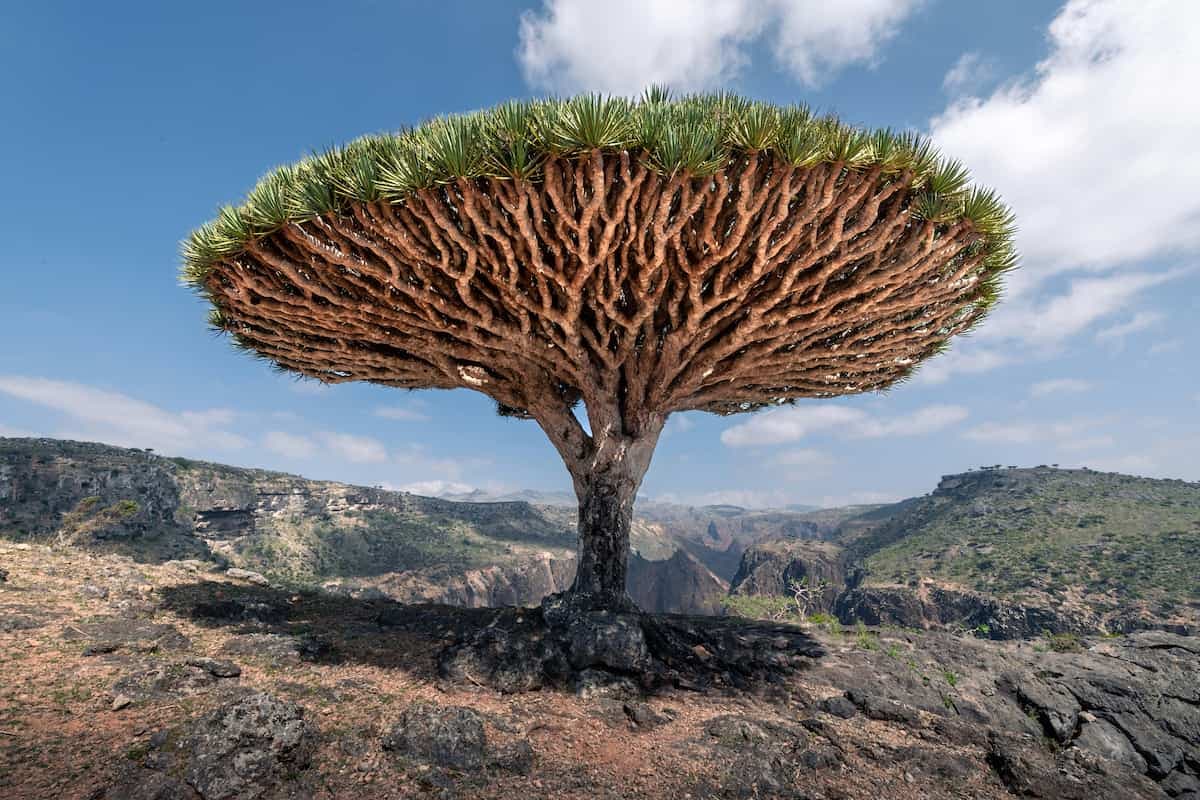
Dragon’s Blood Trees of Socotra
Dragon’s Blood Trees of Socotra: The Island’s Most Iconic Symbol
The Dragon’s Blood Tree is one of the most recognizable symbols of Socotra Island, Yemen. With its unusual umbrella-shaped crown, thick branches, and deep red resin, the tree looks unlike almost any other plant in the world.
For many visitors, seeing these trees scattered across the mountains and plateaus of Socotra is one of the highlights of the entire journey.
A Tree Found Almost Nowhere Else
The Dragon’s Blood Tree, scientifically known as Dracaena cinnabari, is native to Socotra.
It has adapted to the island’s dry climate and rocky highlands, where rainfall can be limited and conditions are often harsh.
Its wide, dense crown helps collect moisture from mist and light rain, allowing water to drip toward the roots.
This unusual shape is one of the reasons the tree has survived in such a difficult environment.
Why Is It Called Dragon’s Blood?
The name comes from the tree’s dark red resin.
When the bark or branches are damaged, the tree produces a red substance that has been called “dragon’s blood” for centuries.
Historically, this resin was traded and used for purposes including dyes, varnishes, traditional remedies, and incense.
Its strong color and mysterious appearance helped create legends around the tree.
An Ancient Tree With a Long History
Dragon’s Blood Trees have been associated with Socotra for thousands of years.
Ancient traders knew Socotra for valuable natural products, including aromatic resins and plant materials.
The red resin of the Dragon’s Blood Tree became one of the island’s most famous exports.
Over time, the tree became closely connected with the identity of Socotra itself.
Where to See Dragon’s Blood Trees
Some of the best places to see large numbers of Dragon’s Blood Trees are in the central highlands.
Diksam Plateau and Firmihin Forest are among the most famous areas.
Here, hundreds of trees can be seen across rocky landscapes, creating one of the most distinctive views on the island.
The trees are especially impressive at sunrise, sunset, or when low clouds and mist move across the plateau.
Firmihin Forest
Firmihin is one of the most important Dragon’s Blood Tree forests on Socotra.
The area contains a dense concentration of mature trees and offers visitors a chance to walk through a landscape that feels almost prehistoric.
From a distance, the crowns form dark umbrella-like shapes across the mountains.
Up close, the thick trunks and twisting branches reveal just how unusual these trees are.
Diksam Plateau
Diksam Plateau is another major location for seeing Dragon’s Blood Trees.
The plateau combines the trees with deep canyons, mountain scenery, and open views across central Socotra.
Visitors can hike between trees, stop at viewpoints, and explore areas near Dirhur Canyon.
For photographers, Diksam offers some of the most dramatic compositions on the island.
A Tree Built for Survival
The structure of the Dragon’s Blood Tree is perfectly adapted to Socotra’s environment.
Its branches grow upward and outward, creating a dense crown.
This crown provides shade, reduces water loss, and helps capture moisture from the air.
The tree can survive in places where many other plants would struggle.
This makes it one of the best examples of how species on Socotra have evolved in isolation.
Threats to the Trees
Despite their strength, Dragon’s Blood Trees are vulnerable.
Climate change, changing rainfall patterns, grazing animals, and slow regeneration can affect young trees.
Many mature trees are old, but younger trees are not always replacing them quickly enough.
This creates concern for the future of some Dragon’s Blood Tree populations.
Conservation
Protecting Dragon’s Blood Trees is essential for preserving Socotra’s unique environment.
Conservation efforts focus on protecting forests, reducing damage from grazing, and encouraging the growth of young trees.
Visitors can help by avoiding damage to roots, branches, and bark.
The trees should never be carved, cut, or used as climbing structures.
Photography and Travel
Dragon’s Blood Trees are among the most photographed features of Socotra.
Their unusual shape creates dramatic silhouettes against the sky.
Sunrise and sunset are especially popular because the low light emphasizes the branches and surrounding landscape.
Fog and clouds can make the forests look even more mysterious.
A Symbol of Socotra
More than any other plant, the Dragon’s Blood Tree has become a symbol of Socotra.
It represents the island’s isolation, biodiversity, and unusual natural history.
For travelers, seeing these trees in person often creates the strongest impression of how different Socotra is from anywhere else.
Final Thoughts
The Dragon’s Blood Tree is not simply a beautiful plant.
It is part of Socotra’s history, culture, ecology, and identity.
Its red resin once connected the island to ancient trade routes, while its unusual shape continues to attract scientists, photographers, and travelers from around the world.
Walking among Dragon’s Blood Trees in Diksam or Firmihin is one of the experiences that makes Socotra truly unforgettable.